


From creating images to curating social media feeds tailored to our interests, artificial intelligence (AI) has become part of everyday life. It is changing how we learn, work, and interact with the world. As AI becomes increasingly embedded in everyday life, it is important that our students learn to use it safely, responsibly, and confidently.
1. Why are we introducing AI to primary school students? Isn't that too early?
Introducing AI concepts early helps students understand what AI is and how to use it safely in an age-appropriate manner. At the primary level, our focus is on building strong foundations while nurturing the students' curiosity about the world. We prioritise physical, hands-on learning and meaningful social interactions, particularly for lower primary students, to help them build foundational knowledge and develop cognitive and social skills. Schools will not require Primary 1 to 3 students to use AI chatbots for schoolwork, though AI may be used to support teachers to provide customised feedback to students. The emphasis is on helping students understand what AI is, its benefits and risks and how it appears in everyday life.
By Primary 4, students would have developed foundational literacy and numeracy skills, a basic understanding of AI, and some level of executive functioning skills such as planning, task initiation, and self-evaluation. AI tools specifically designed for education, and primarily those in the Singapore Student Learning Space (SLS), will be gradually introduced in selected classroom tasks under teacher supervision and guidance.
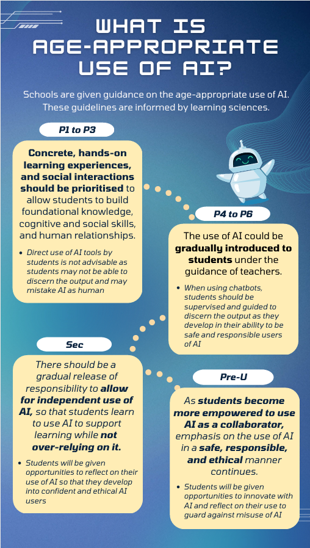
A Quick Guide for Parents on AI
More information on MOE's approach to AI in schools can be found here.
2. How can we protect our students from the risks in AI?
Protecting students from the risks in AI is not just about limiting access. It is also about equipping them to use AI safely and responsibly.
Through the curriculum, co-curriculum and self-paced SLS modules, students learn how AI works, its benefits and limits, and how to use it to support learning. In Cyber Wellness lessons under the Character and Citizenship Education curriculum, students learn about digital safety and security, digital responsibility, and digital information management. Upper primary students also complete the mandatory Code for Fun programme, which introduces computational thinking, block-based coding and basic AI.
3. How do we prevent students from becoming over-reliant on AI?
We recognise that the convenience of AI can make it tempting for students to rely on it. That is why we take a deliberate approach to introducing AI in schools.
Students are first introduced to AI tools within SLS, which are pedagogically sound and have in-built guardrails that allows students to engage with AI in a calibrated and controlled manner. These tools do not give direct answers, but support learning through questions, scaffolds and feedback. Students are taught how the tools work and how to use them meaningfully, while teachers reinforce good learning habits and critical thinking.
As students progress to secondary school, they begin to use AI more independently through well-designed learning tasks, such as project research and ideation, and in Applied Learning Programmes. By gradually increasing students' exposure to AI, we aim to develop confident and discerning learners who know when and how to use AI, and when to rely on their own thinking.
|
Click on the below links to find out how schools are using AI: |
4. What is the difference between SLS AI tools and commercial AI products?
Commercial-off-the-shelf (COTS) AI tools are mostly general-purpose and built for broad everyday tasks while the AI tools within SLS are educational in nature and designed for learning. They guide students through learning instead of giving direct answers. Built-in guardrails also help reduce risks, such as students relying too much on AI or losing confidence in their own thinking.
SLS AI tools are continually refined based on student and teacher feedback. They also protect students' data by ensuring it is anonymised and not used to train any external AI models.
|
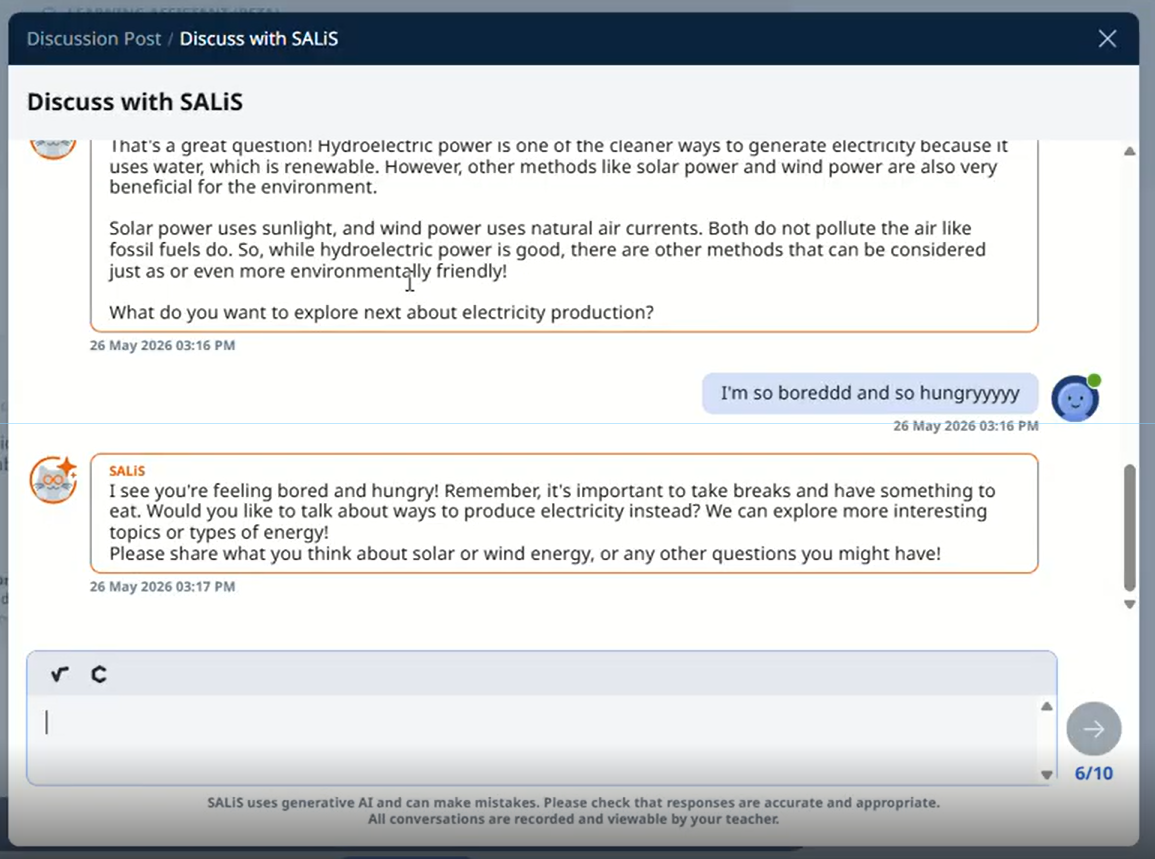
Did you know? The Learning Assistant (LEA) does not provide direct answers or prolong conversations. Instead, it encourages thinking and reflection through iterative questioning. A teacher can set the maximum number of interactions each student can have during a discussion. If students go off topic or ask questions unrelated to their learning, the LEA will redirect them back to the learning task. Screenshot of the Learning Assistant (LEA) redirecting a student back on task
Screenshot of the Learning Assistant (LEA) redirecting a student back on task Find out more about other SLS AI tools here. |
5. If students can turn to AI for information and explanations, what role do teachers play?
While AI can support learning by providing explanations and personalised feedback, teachers remain central to designing meaningful learning experiences. The role of teachers becomes even more critical when AI becomes more pervasive, as they mentor our students and nurture in them human qualities such as empathy and resilience, and help them to develop the judgement to use AI responsibly.
Teachers play the role of learning designers to decide when and how AI should be used, based on students' age and readiness. They help students to think critically about AI's responses, and how to use AI wisely. They monitor and guide students to ensure sound values and 21st century competencies are developed, and learning outcomes are achieved.
MOE will support teachers to "learn about, learn to use, learn with, and learn beyond AI" through professional learning and development so that they remain grounded in strong pedagogical practices and continually hone their craft as learning designers to ensure that our students develop holistically.
6. What can parents do to guide their child's use of AI?
Here are some tips on how to support your child in using AI:
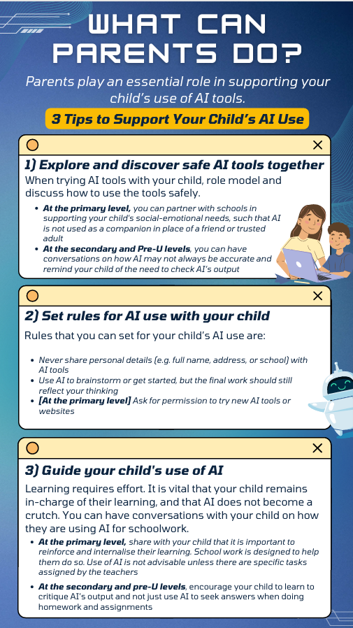
Parents are our key partners in helping children use AI meaningfully, safely, and responsibly.
MOE will continue to share resources on how schools use AI and provide tips on how parents can guide their children on AI use through Parent Gateway and MOE's social media channels.
By working together, schools and parents can help students develop the confidence, judgment and resilience to thrive in an AI-enabled world.
|
Click on the below links for resources to how to guide your child when using AI: |