Last Updated: 27 Jan 2026
Normal (Academic) course for secondary school
Normal (Academic) course at a glance
- Course type
-
Academic
- Course length
-
4 or 5 years
- Course eligibility
-
PSLE Score 21 - 25*
* PSLE Scores of 21 - 22 are in the Express/Normal (Academic) Option Band
* PSLE Score of 25 is in the Normal (Academic)/Normal (Technical) Option Band - Subjects at lower secondary
-
Students are exposed to a wide range of subjects at the lower secondary level to:
- Help them make informed choices on their subjects at upper secondary level and beyond.
- Prepare them to cope with these subjects at upper secondary level.
The subjects offered are:
- English Language
- Mother Tongue Languages
- Mathematics
- Science
- Character and Citizenship Education
- Humanities, such as Geography, History and Literature in English
- Design and Technology
- Food and Consumer Education
- Physical Education
- Art
- Music
- Project Work
- Compulsory subjects at upper secondary
-
English Language, Mother Tongue Language, Mathematics, Science, Humanities (with Social Studies)
- Options and electives
-
- Students who have obtained AL 5 or better in a Standard level subject at the PSLE will have the option to take the subject at the Express level through Subject-Based Banding (SBB).
- From 2024, secondary schools will implement Full SBB. Learn more about it.
- Elective subjects available at upper secondary
- Elective programmes available
- Students who have obtained AL 5 or better in a Standard level subject at the PSLE will have the option to take the subject at the Express level through Subject-Based Banding (SBB).
- Certifications offered
-
- Secondary 4: GCE N(A)-Level and/or GCE O-Level (for subjects offered at O-Level)
- Secondary 5: GCE O-Level
- Next educational level
-
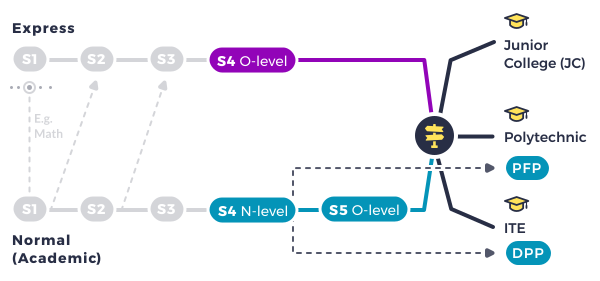
After N-Level:
- Normal (Academic) at Secondary 5 for GCE O-Level examination
- Polytechnic through the Polytechnic Foundation Programme (PFP)
- Nitec Programme offered by the Institute of Technical Education (ITE), or
- Higher Nitec Programme via the Direct-Entry Scheme to Polytechnic Programme (DPP) offered by the Institute of Technical Education (ITE)
After O-Level:
- Junior college, Millennia Institute, polytechnic or Institute of Technical Education (ITE)
Taking Express level subjects
Lower secondary students can take certain subjects at the Express level through Subject-Based Banding (SBB). Your child can take subjects at the Express level if:
- They obtained AL 5 or better at the Standard level for that subject at the PSLE.
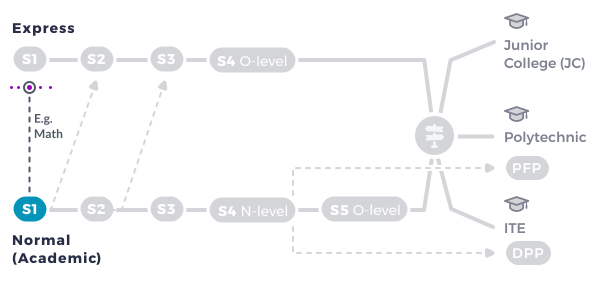
- They do well in the school-based examination, and the school finds them suitable after starting Secondary 1.
Transferring to the Express course
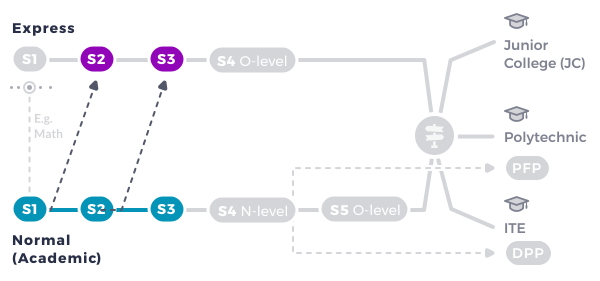
Your child may transfer to the Express course at the end of Secondary 1 Normal (Academic) or the end of Secondary 2 Normal (Academic).
Transfers are based on student performance, and the professional assessment of their teachers and principal. Speak to your child’s school for more information on transfer criteria.
GCE N-Level and O-Level examination
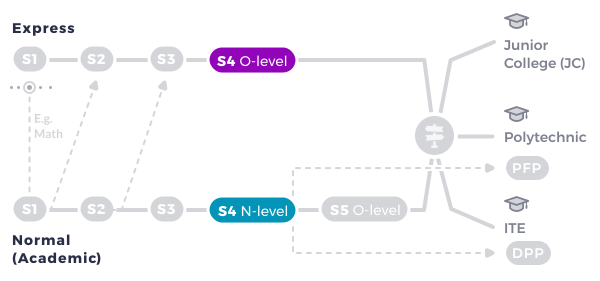
At the end of Secondary 4, your child will sit for the GCE N-Level examination. They will need to take at least 5 and up to 9 examinable subjects.
If your child is taking any Express course subjects, which counts towards the minimum and maximum number of subjects allowed as mentioned above, they may sit for the O-Level examination in that subject at Secondary 4.
If your child is a Secondary 5N(A) student, O-Level subjects that were taken in Secondary 4N(A) will count towards the total number of O-Level subjects they take in the GCE O-Level Examination at the end of Secondary 5. Your child should continue to take at least 5 distinct O-Level subjects in total across their 4N(A) and 5N(A) years.
After Secondary 4
Depending on your child’s results at the GCE N-Level examination in Secondary 4, they can:
- Enrol directly in ITE for a National ITE Certificate (Nitec) or Higher Nitec course through the Direct-Entry-Scheme to Polytechnic Programme (DPP).
- Apply for the Polytechnic Foundation Programme (PFP) and enrol in a Polytechnic.
- Continue to Secondary 5 and sit for the O-Level examination. Based on their O-Level results, interests, strengths and learning goals, they can consider progressing to junior college, Millennia Institute, polytechnic or the Institute of Technical Education (ITE).
Polytechnic Foundation Programme (PFP)
PFP is a one-year programme taught at polytechnics, as an alternative to Secondary 5.
If your child passes all their PFP modules, they will be admitted to a polytechnic diploma programme.
PFP eligibility is based on students’ N-Level aggregate score.
Direct-Entry-Scheme to Polytechnic Programme (DPP)
DPP allows students to take a two-year Higher Nitec course at the ITE as an alternative to Secondary 5.
If your child successfully completes the course with the minimum grade-point-average (GPA), they will be admitted to the first or second year of a related polytechnic diploma programme.
DPP eligibility is based on students’ N-Level aggregate score.
Progression to Secondary 5N(A)
Secondary 4N(A) students can progress to Secondary 5N(A) and sit for the O-Level examination based on their N-Level examination results.
To be eligible for progression to Secondary 5N(A), your child will need a raw ELMAB3 (English, Mathematics and the best three subjects) of 19 points or better (excluding CCA bonus points) and at least a N(A)-Level Grade 5 for all subjects used in the computation of the ELMAB3.