


INTRODUCTION
1. As a small nation without natural resources or hinterland, Singapore's success has always depended on our people. Education has been a core engine that equips Singaporeans with what they need to take on new challenges.
- In the post-independence years when survival was priority, we focused on basic education.
- In the late 70s, we shifted away from a one-size-fits-all approach, and improved educational outcomes through streaming and differentiated pathways.
- From the late 1990s, we broadened our definition of success by recognising diverse strengths and abilities.
- Since the 2010s, we have increased emphasis on students' holistic development and strengthened lifelong learning.
2. During the Budget and COS debates, Members spoke about the uncertainty and challenges brought about by the geopolitical paradigm shift, AI and the existential threat of climate change, and proposed many ways to better prepare Singaporeans through education for the future. I thank Members for your suggestions, which we will study carefully.
3. In our next bound of education reform, we want to support every Singaporean to learn and reach their full potential, regardless of starting point, and to seize opportunities in a fast-changing world. In line with PM's call for a "We First" society, we will "Learn for Life, Together".
4. Today, I will speak about how we will refresh our education system in three ways.
- First, we will learn together. Students of different strengths and needs will be developed to their full potential. We will also uplift disadvantaged students, and support those with Special Educational Needs.
- Second, we will grow together. To prepare students for the future, we will further strengthen our focus on holistic development, where students develop core values and critical life skills, and learn to interact and build bridges across differences, instead of just chasing after academic grades. We will also encourage and equip our students to be innovative and enterprising, to pursue deep learning in an AI-transformed world, and support them in their journey towards lifelong learning.
- Lastly, let us work together - educators, parents, as well as industry and community partners - to build a stronger education ecosystem.
5. My colleagues will share in greater detail how we will achieve some of these efforts.
- SMS David Neo will speak about creating a student-centric education system.
- SMS Janil Puthucheary will explain how we support lifelong learning beyond schools.
- MOS Jasmin Lau will share how we are preparing Singaporeans for an AI-transformed future.
- And SPS Syed Harun will set out our efforts supporting students with Special Educational Needs (SEN) and strengthening bilingualism.
LEARNING TOGETHER WITH DIFFERENT STRENGTHS AND NEEDS
6. Let me turn to the first theme of learning together.
7. Our education system serves a broad spectrum of learners.
- Through FSBB or Full Subject-Based Banding, students can build on their strengths in different subjects, and learn at their own pace.
- We stretch those with academic strengths and talents, while providing additional support to disadvantaged students.
8. Let me share the progress we have made so far.
Full Subject-Based Banding and Higher Mother Tongue Changes
9. Over the years, we have made moves to customise education.
10. Notably, Full Subject-Based Banding allows secondary school students to take subjects at different levels based on their strengths, interests, and learning needs.
- The first cohort of students under Full Subject-Based Banding will be sitting for the Singapore-Cambridge Secondary Education Certificate (SEC) examination in 2027 and will progress to post-secondary education in the following year.
- This common examination gives us the opportunity to streamline several admissions exercises into a single Post-Secondary Admissions Exercise for admissions to Junior Colleges, Millennia Institute, Polytechnics and ITE in the year 2028, which will improve students' user experience and decision making. My colleague SMS David Neo will provide more details.
11. Another move we implemented this year is to allow students who did well in Mother Tongue at PSLE to take up Higher Mother Tongue from Secondary 1, regardless of their overall PSLE score.
- This will give around 2,500 more students the opportunity to pursue their passion for their Mother Tongue Language.
- It is part of our broader effort to recognise and nurture the students' strengths as well as interests.
12. Mr Darryl David and Dr Jamus Lim asked for smaller class sizes to better customise education. Ms Denise Phua called for a flexible class size model, "right-sized" and fit for students' needs.
13. This proposal has been raised over the years by Members from both sides of the House. We agree that having smaller class sizes can improve teaching and learning, as teachers can better cater to the learning needs of their students.
14. That is precisely why we have smaller class sizes for students with greater needs. We deploy more teachers and allied educators to support and scaffold their learning, and channel more of our resources to help them learn. The average form class size for primary and secondary schools is 34 and 33 today, respectively. In upper primary, foundation subjects are taught in smaller classes, which in most instances can be 10 to 20. For the learning support programme, class size is about eight to ten. In Full Subject-Based Banding, different subject classes range between 20 and 40 students based on students' learning needs and the nature of the subject.
15. We are learning from our experience over the last few years with smaller class sizes for students with greater needs, and studying how best to calibrate class size to bring about engaging and effective learning environments for our students, while managing teacher workload.
16. Dr Lim asked why we cannot simply hire more teachers to bring class sizes down. He took issue with MOE's explanations that it is not easy to hire many more teachers, and that quality may suffer. But these are not trivial challenges. We have already ramped up teacher recruitment significantly – from 700 a year previously, to our current target of over 1,000 new teachers a year. That is already a 40% increase. And last year, we recruited over 1,300 teachers. But we would need to increase this much further to achieve across-the-board class size reductions.
17. At the same time, we are contending with a tight labour market, especially for those we want to recruit as teachers. We need to select not just for those with qualifications, but also the aptitude to teach and the heart to nurture future generations. Yet our local workforce growth is slowing, and Singaporeans have many attractive career options in the public and private sector. So this is hardly a simple fix.
18. Dr Lim also suggested hiring more Allied Educators. In fact, as I shared in November, we have doubled the number of allied educators in priority areas such as counselling and special education needs across all schools over the last ten years, from about 800 to 1,600. The number of administrative support staff in each school has also increased from around 6 to around 9 in the same period, to help teachers offload some of their administrative workload.
- In expanding our allied educator pool, we have focused on the high-priority, more specialised support functions that our schools and teachers need the most, such as School Counsellors and SEN or Special Educational Needs Officers. They play important complementary roles alongside teachers, in supporting students of different strengths and needs.
- To achieve this with the limited manpower available, we have been progressively scaling back the deployment of Allied Educators in Teaching & Learning, and helping them to transition into roles of greater need over the past nine years, through work attachments and training. This was reported in the media in 2016, a PQ by Yip Pin Xiu in 2019, a PQ by Leon Perera in 2020, and by a PQ by Dr Jamus Lim in 2025. So contrary to the Member's claim, this is not a new shift, announced in tandem with the increase in teacher recruitment. I thought to set the record straight, to soothe the "sucker punch" that the Member said he felt, and to make clear that the Ministry had not been "disingenuous".
19. Dr Lim also suggested that CCAs and learning journeys are secondary to classroom instruction, and can thus be outsourced to free up teachers' time so that they can teach more academic classes.
- While MOE has indeed been bringing in coaches, instructors, and administrators to help relieve teacher workload by running CCAs, let's be clear.
- CCAs are an important part of holistic development. And our teachers' roles in CCAs are not merely administrative. They help nurture our students to develop critical socio-emotional competencies.
- So if we were to reduce class sizes by restructuring teachers' duties and asking them to teach more academic classes, we would need to weigh the possible impact on students' holistic development, and teachers' overall working hours.
- As you can see, the considerations underlying class sizes are not simple and straightforward. But Dr Jamus Lim, Mr Darryl David and Ms Denise Phua can be assured that we are studying them carefully, to better support our teachers and students in a sustainable way for the long term.
Refreshed Approach to Support Primary School Students with Academic Strengths and Talents
20. Next, as announced in 2024, we will refresh how we support students with academic strengths and talents, and discontinue the Gifted Education Programme (GEP) in its current form. We are ready to share some of our implementation details.
21. Today, all primary schools already offer school-based programmes beyond the curriculum to stretch and challenge students who have strengths and talents in English, Mathematics and Science.
- Take Blangah Rise Primary for instance. They have debate competitions and E2K Math and Science.
- As PM had shared at the 2024 National Day Rally, we will broaden access to such school-based programmes, from around 7% of the cohort today to 10%.
- On Ms Elysa Chen's queries, these students will be taught by trained educators. Today, almost all primary schools have at least 5 teachers trained to teach such students. Where needed, MOE will provide additional teacher resourcing to schools. Teachers and school counsellors will also be given training, curriculum resources and professional development. Through these, schools can better support their students, encouraging exploration, creativity, and personal ownership of learning.
- Students who can benefit from further stretch can choose to attend centre-based advanced modules after school, at a nearby school centre. They will no longer need to leave their school and transfer to another school that hosts the GEP for daily learning. Instead, they will remain in their own schools, and continue to learn with their friends.
22. Besides English, Mathematics and Science, there will be interdisciplinary modules inspired by real-world problems.
- To be clear – these modules are not intended to give students a leg up in examinations. Rather, they are designed to further cultivate curiosity, creativity and critical thinking.
- Take, for example, the interdisciplinary module on "Playgrounds". Students will explore them as community systems, integrating Social Studies, Science, and Mathematics to tackle real world design challenges. They will study how to make such spaces safe, investigate the science of movement, and through empathy exercises, design inclusive playgrounds for diverse users.
- Last year, we conducted a trial of these modules, which was well-received.
- Compared to the current GEP cohort, at least double the number of students will be able to take these centre-based modules, which cater to students with strengths in both specific as well as multiple domains.
23. As a start, there will be 15 centres hosted by primary schools across Singapore, such as Palm View Primary and Yew Tee Primary. These schools have good geographic spread and are accessible via public transport. The centre locations will be reviewed periodically.
24. The first batch of Primary 3 students will participate in a standardised one-stage identification exercise this August, instead of the current two-stage process.
- Schools can also identify students using additional sources of information, such as teacher observations and student work.
- Rather than having a single entry point at Primary 4, students can also join at the end of each semester at P4 and P5, making this more porous.
Students from Disadvantaged Backgrounds
25. Next, let me speak about how we are helping students from disadvantaged backgrounds.
26. Education has helped spur social mobility in Singapore. We want our children to know that as long as they are prepared to put in effort, they can do well in life regardless of their starting point.
27. We would like to assure Mr David Hoe and Mr Abdul Muhaimin that MOE provides additional support for disadvantaged students in their education journey and that financial barriers will not impede their educational aspirations and progression.
- From Academic Year 2026, we raised the income eligibility criteria and financial assistance amount for Singaporean students to benefit 31,000 more students from lower- to middle-income households. In total, about 133,000 students will benefit annually.
- In addition, students from lower-income households can tap on the MOE Opportunity Fund for co-curricular activities, learning experiences and personal learning devices.
28. Mr David Hoe will be glad to hear that we also have measures to support these students' aspirations.
- Today, about 100 primary and secondary schools with a higher proportion of students from lower-income households receive additional resourcing for after-school programmes. These include mentoring, interest-based activities and learning journeys, which broaden students' perspectives and develop their aspirations.
- The Centennial Fund Award also supports Polytechnics and ITE students from disadvantaged backgrounds by providing mentorship to guide them on their career and life goals.
29. Let me share with you Sally's journey. Sally, whose name has been changed to protect her privacy, is a Primary 6 student at Naval Base Primary School. She was anxious in school and lacked confidence in her studies because of her challenging home environment and her burden of having to care for her younger brother after school each day.
30. Sally's teachers encouraged her to join the school's Beacon for Life programme, which is an after-school programme supported by MOE, which offers academic support as well as activities that build teamwork, resilience and emotional well-being. The school also worked with community partners to customise support for Sally, and Sally's family also received MSF ComCare and assistance from a Family Service Centre.
31. The wraparound care and support given to Sally helped build her confidence in school and social interactions. Today, Sally participates actively during lessons and her CCA. Sally's journey illustrates what we can achieve when schools and communities collaborate closely to uplift our students and their families.
32. MOE will strengthen our support for disadvantaged students like Sally, and schools' partnership with the community in support of ComLink+. Existing initiatives such as UPLIFT Enhanced School Resourcing (UESR) and GEAR-UP, which respectively provide additional resourcing and school support such as after-school programmes, will be streamlined into one single support package, which we will further enhance.
- From this year 2026, we will devote even more resources to schools, expanding the number of schools with additional manpower and funding from 100 to 157.
- Our schools will provide customised support to students, by strengthening partnerships with community stakeholders, such as self-help groups and others.
- We will also provide stronger and more timely wraparound support for students and their families by tightening coordination between schools and key agencies, such as Social Service Offices and Family Service Centres.
- Our goal is clear: We want every child in our schools to achieve his or her full potential, regardless of background. But that would mean all of us have to work even more closely together.
Supporting Students with Special Educational Needs
33. Next, we have made significant progress over the years in supporting students with moderate-to-severe SEN, who attend Special Education (SPED) schools. This includes:
- Enhancing curriculum quality through a National SPED Curriculum;
- Strengthening partnerships between General Education and SPED schools; and
- Professionalising SPED educators.
34. We thank families, Social Service Agencies, and other government agencies, who partner us in the broader SPED ecosystem. Through our collective efforts, we help students live independently, learn for life, participate meaningfully in the community, and sustain meaningful employment for those who can access work.
35. We will work with Social Service Agencies to build more SPED schools and provide more SPED school spaces amidst rising demand, while continuing to support students with SEN in our mainstream schools. My colleague SPS Syed Harun will share more details later.
GROWING TOGETHER THROUGH HOLISTIC DEVELOPMENT AND CONTINUING LEARNING
36. Let me now turn to our efforts to help our students develop holistically.
Overcoming the Education Arms Race and Instilling the Love for Learning
37. Our education system has long been recognised for its academic rigour and excellence. While these remain important, they have never been our only focus. As our world rapidly transforms, we don't want our students to simply be good at acing exams today. We want them to be trailblazers for tomorrow.
38. This calls for a reimagination of education – a reform and refresh of how we prepare our students to be resilient, well-rounded, and thoughtful. To achieve this, one challenge we must first confront honestly is the education arms race.
- Many parents still regard PSLE and DSA as measures of success, which is perfectly understandable.
- If we were to look deeper, these perceptions stem from the belief that getting into popular schools will help their children do well in life.
39. The fixation on grades and achievements, and the excessive competition it generates, draws us away from what really matters. It diminishes the joy of learning. It takes away time from character building. And it pits our children against one another.
40. We know it takes more than just academic grades to do well in life and in the workplace. Preparing for the future, especially one that is so uncertain, means anchoring our education system in holistic development. To reduce the overemphasis on academic grades, we have, in recent years:
- Replaced PSLE T-scores with broader Achievement Levels;
- Reduced the number of subjects required for JC admission from six to five from 2028; and
- Allowed students to offer one 'Best' subject at minimally G2 level – or Normal (Academic) level equivalent – for Polytechnic admission from 2028.
41. We will build on this momentum and study moves to further break away from the education "arms race" in favour of more holistic development.
- Ms Denise Phua, Dr Kenneth Goh and Ms Eileen Chong share our intent to reduce the stakes of our assessment milestones. We are not closed off to any ideas and will consult widely. For example, we are prepared to review:
- How we conduct milestone exams and how the difficulty of such examinations should be calibrated;
- How DSA can be enhanced to strengthen student development, selection, and its accessibility, so that it continues to meet its objectives; and
- How we post students to secondary schools, including the viability of through-train options as discussed and suggested by Ms Denise Phua, amongst other areas.
42. Over the years, many MPs, most recently Mr Foo Cexiang at the Budget debate, have raised questions about why there is a need to set challenging questions at PSLE for secondary school selection. Ms Eileen Chong had also asked to remove the competitive grading element in PSLE.
43. To address these questions, we must first consider what the role of PSLE is.
- The PSLE serves as a checkpoint to assess students' understanding of core concepts and skills in the Primary School curriculum.
- It helps guide students into appropriate secondary school subjects and pathways that will best support their learning aspirations and needs. To do this, we need a fair and consistent benchmark across all primary schools in Singapore and for students across all backgrounds.
44. The PSLE today has a range of questions of varying difficulties, to help us identify students who might need more support with building up their foundations, as well as students who can benefit from further stretch in their next stage of learning. As such, every PSLE paper has a carefully calibrated balance of questions to cater to students of different abilities: 85% are easy and moderate, with 15% challenging questions.
45. For challenging questions, Members may like to know that students are provided with scaffolding support to help them apply the concepts and skills that they have learned in less familiar contexts.
- With your permission, Chairman, may I ask the Clerks to distribute a Mathematics question?
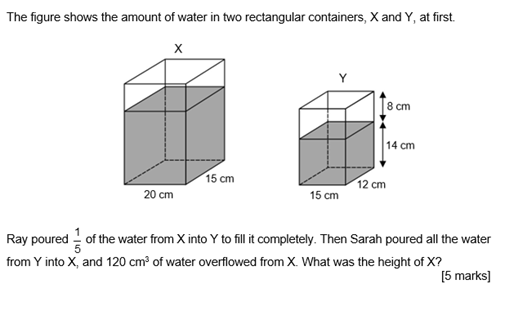
- This question assesses problem-solving skills, by testing how students apply mathematics in less familiar situations. In this case, the overflow of water, with real-world applications in future such as engineering.
- As you can see, this question is a bit more challenging.
- Now, turn over the sheet, and compare this with the question on the next page.

- This is essentially the same question, but structured – meaning that the question has two parts: (a) and (b). The questions are (a) 2 marks and (b) 3 marks, versus the first question, which dives straight in five marks at one go.
- Part (a) is included to guide students to first find the volume of water in container X, which is the first step to solving the problem.
- Most students can solve Part (a) and this is considered easy.
- Part (b) is more demanding, because when water was poured back from Y to X, some water overflowed. This assesses students' critical thinking to account for this change. But this is all based on the primary school syllabus and does not require knowledge beyond the syllabus.
- The difference between the two questions is clear, and this second question you were looking at was a math question from PSLE in 2022. To help our students, challenging questions are often structured with scaffolding to help students attempt them progressively.
Developing Students Holistically and Supporting Aspirations
46. On this note, we agree with Ms Eileen Chong that examinations, such as the PSLE, should not define students' self-worth. We also agree with Ms Denise Phua and Dr Kenneth Goh that our schools should not just focus on academic results, and they indeed do not. Because we recognise that ultimately, while grades might be the boat that gets you out to sea, it is resilience that keeps you afloat when storms hit. It is adaptability that helps you navigate changing currents. It is creativity that helps you spot new horizons, and it is interpersonal skills that will bring others with you in your journey.
47. Therefore, our schools seek to nurture students for life. And we broadly do so in two ways.
48. What are these two ways? First, we place a lot of emphasis on holistic development.
- At the primary, secondary and Junior College levels, students develop 21st Century Competencies (21CC) such as adaptive and inventive thinking and civic literacy through the learning of subjects, Character and Citizenship Education (CCE) curriculum, CCAs and school-based programmes.
- Our Institutes of Higher Learning also build on schools' efforts by infusing LifeSkills such as interpersonal skills and innovation into curriculum.
49. Second, we cultivate students' aspirations. When I visit our schools, I like to ask our students what they dream of becoming when they grow up.
- Some enjoy coding and say they want to work in IT or AI.
- Some are inspired by their teachers and want to become educators themselves.
- I also recall an enterprising student who told me that he dreams of starting his own business!
50. It is good that our young ones are full of hopes and aspirations.
- Every child should dare to dream.
- But our children also need to learn that, for dreams to become reality, they need to take active steps and be resilient in dealing with challenges and setbacks along the way.
- We also need to consider those who might not yet be sure about what they want to do when they grow up.
51. We are therefore aligned with Mr David Hoe and Mr Shawn Huang in providing our students exposure to the next stage of their school or work life.
- For example, some secondary schools offer Applied Learning Programmes (ALP) in areas such as Business and Entrepreneurship, to connect classroom learning with real-world experiences.
- Our Polytechnic and ITE students are required to complete internships and can participate in career fairs, mentorship programmes, and industry visits.
- These give our students exposure to different careers and industries to allow them to make more informed decisions on future pathways.
52. Today, I've shared some of the moves we are exploring in government. But no one has a monopoly on good ideas. That is why, in continuation of our efforts from Forward Singapore, we will start a series of Education Conversations.
- We intend to engage and consult educators, parents, researchers, students, and the community. We will review your ideas and suggestions. And we will study other countries and learn from their best practices.
- Together, we will seek to create solutions that will ensure that our education system continues to meet our current and future needs, in particular, with the changing and uncertain environment ahead of us. More details will be shared when ready.
P1 Registration Framework
53. Next, we also want our schools to be active platforms that bring together students from different backgrounds. After all, it is in our classrooms, school halls and sports arenas, where friendships are formed. And when students share their love of sports, music or Mathematics, they discover that they are more similar than different. These interactions allow our students to bridge differences and develop social emotional skills.
54. Our schools intentionally bring together students from different schools and different backgrounds. For instance, we have combined school CCAs or cluster-based CCAs where students from different schools and backgrounds come together to learn and train on regular basis.
55. Over the years, we have also made changes to the P1 Registration Framework to expand access for students with no prior connections to enter our primary schools. We had reserved 20 places at Phase 2C in 2014, which is open to students regardless of whether they have prior connections to the school. This was further increased from 20 to 40 in 2022. This has ensured open access to all primary schools via Phase 2C. Today, many of our schools have a good mix of students from families of different socio-economic statuses – or SES.
56. Nevertheless, there are still some schools that are overrepresented by students from higher-SES families.
- Some of these schools are located in neighbourhoods that comprise mostly private housing, with fewer public housing.
- If the school is popular with parents, it might be filled first by those living nearest in private housing, because of the home-school distance priority.
57. Schools cannot just passively reflect the neighbourhoods around them, but they must also actively create diverse environments for our students to mix and mingle and to learn from one another.
58. We have received many suggestions on the P1 Registration Framework.
- Mr David Hoe, Ms Lee Hui Ying and others have suggested removing the priority phases for children and siblings of alumni, including the affiliation advantage at Secondary 1 posting, as they feel that this is unfair and exclusionary.
- Others have said the same of children whose parents volunteer for the school and community, because not every parent has the time and resources to do the same.
- Others support keeping things as they are, believing these connections help build school culture and shared values across generations.
- On proximity, we have also heard equally diverse views. Some parents feel that proximity should be the most important consideration, so that students do not spend much time traveling to and from school. Others want to widen or even remove the home-school distance bands altogether, so that parents who can afford to buy or rent property near their preferred school do not get an unfair advantage.
- Some have suggested that the same P1 framework should not be rigidly applied to all schools. Especially if the school's neighbourhood comprises mostly some types of housing over others, some have suggested that others from slightly further away be given some access. For such schools, alumni priority could draw in diverse students from a wider geographical range, instead of only students from the nearby private estate.
59. These are all well-meaning suggestions, and what I've just said is not exhaustive and we take every one of them seriously. But at the end of the day, we have to find the right balance between these competing views and needs, because there are a finite number of places in each school, and every change we contemplate would affect different groups in different ways. And as society evolves, we need to adjust this balance over time.
60. Let me assure Members that MOE is reviewing the Primary 1 Registration Framework so that our primary schools remain open to students from different backgrounds. We will announce more details when ready.
Adapting Together in an Ai-Transformed Future
61. Now, let me talk briefly about AI. The rise of AI has changed the world as we know it. AI can increasingly accomplish more complex tasks and what once took us hours or days, AI can now accomplish in minutes or even seconds.
62. However, for all its capabilities and they are growing, AI is not infallible, nor can it replace the human spirit.
63. To prepare our workforce for an AI-transformed future, our schools and IHLs will equip our students to harness AI. through the four 'Learns':
- First, learn about AI. Students will learn what AI is, how it works, what its impact is, and what the limitations are.
- Second, learn to use AI. Students will learn how to harness AI tools effectively and responsibly, in partnership with the industry.
- Third, learn with AI. Educators will use AI in teaching & learning to enhance students' learning outcomes; and
- Fourth, perhaps the most important, learn beyond AI. Educators will help students develop other critical skills, so that they can add human value and use AI to amplify their impact.
64. My colleague MOS Jasmin Lau will provide further details about MOE's AI-related moves, and you must see them in the context of the overall national moves and national strategy on AI.
Lifelong Learning Beyond Schools
65. Next, since we started the SkillsFuture movement in 2015, training participation from both individuals and employers has significantly increased.
66. We have provided significant financial support to empower individuals to take charge of their learning. In 2024, we introduced the SkillsFuture Level-Up Programme to further lower their opportunity costs of training for mid-career workers. We will continue to strengthen accessibility of a larger range of courses for mid-career workers to upskill. My colleague SMS Janil Puthucheary will share more.
67. While we have done well, we can and must do more, and do better, to support Singaporeans in navigating an increasingly complex economic landscape.
68. At Budget 2026, PM announced that SSG and WSG would be reorganised into a new statutory board, jointly overseen by MOM and MOE. The new agency will integrate SSG's training and skills development capabilities, and WSG's employment facilitation ecosystem, to provide stronger end-to-end support for Singaporeans in bridging skills to jobs. My colleague Minister Tan See Leng will share more at MOM's Committee of Supply debate.
69. MOE will continue to steer the SkillsFuture movement together with MOM and the new agency, and work with our IHLs, to provide high-quality, industry-relevant, and accessible training for Singaporeans to upskill.
WORKING TOGETHER FOR A STRONGER EDUCATION SYSTEM
70. Finally, let me talk about working together for a stronger education system.
71. The plans that I have outlined today cannot be achieved by MOE and our schools alone. Everyone has a part to play. Let me thank some of our key partners, in addition to the community partners and social service agencies whom I had mentioned earlier.
- We are grateful to our industry partners who closely collaborate with our IHLs to provide learners with industry-relevant curriculum and real-world experiences that prepare our students for the future.
- We also appreciate our parent and school volunteers who plan engaging activities that strengthen student support and build stronger parent-child relationships.
72. And in particular, I would like to recognise and affirm our educators for the important and hard work that they do day in day out. To our school leaders and teachers: You are the core of our education system. You nurture our students and support their learning – from lessons to remedials, from CCAs to camps, from building trust to journeying with students through difficulties, and so much more.
73. We will continue to ensure that our teachers are fairly recognised for their hard work and dedication. MOE is reviewing the salaries of our educators, including our allied educators and MOE Kindergarten Educators, and will share more when ready.
74. We also recognise that all the things you do for our students take time, effort, and sacrifices. It is therefore important that our teachers' workload remains manageable and sustainable, and we've had extensive debates in this House before.
- I have been sharing at length on our commitment in this front, and we are making steady headway. For instance, by leveraging technology and AI, alongside the Reimagining the Teaching Profession Taskforce's recommendations, we will continue to help recalibrate what teachers do. These include streamlining administrative processes, increasing support structures, and protecting after-work hours, so that our teachers can better balance their professional responsibilities with their personal well-being.
- We will continue to listen to our teachers, and do more to support you.
Mandarin Speech
75. Mr Chairman, I will now speak in Mandarin.
76. 各位同胞,我们今天分享的各项计划,是为了满足国人的学习需求,帮助国人实现理想。无论学生的起点,我们都会让每个人有机会发挥潜能,一起打造"我们为先"的社会。
77. 我们将尽力照顾不同特长和需求的学生,并扶持来自弱势背景的学生。
78. 目前,所有小学都开办了校本增益课程,让在英文、数学和科学有特长的学生得到发展。因此,我们准备让更多学生有机会参加这些课程。这会让每一届受惠的学生从目前的百分之七增加到百分之十。
79. 能够接受更大挑战的学生可以选择在放学后到指定的中心,参加进阶单元。这样,学生就可以继续留在原来的小学就读,无需转校。
80. 这些中心也会开设跨学科单元。这些单元会从生活中的问题出发,引导学生从不同学科的角度切入,了解和解决这些问题。无论是在特定领域或多个领域有特长的学生,都可以选择在学校假期时参加跨学科单元。
81. 今年的小三生是第一批参加新遴选过程的学生。他们将在8月份参加统一测试。就算第一次没被选上,到了小四或小五,学生还是可以通过老师推荐和平时课业表现等其他途径加入这个计划。 如此一来,学生可以按照自己的步调发展特长。
82. 教育是推动社会平等的重要推手。无论家庭背景如何,我们的教育制度必须让每个孩子获得改变命运,打破阶层固化的机会。
83. 从今年起,我们会投入更多资源,支持学校的课后活动,为来自低收入家庭的学生提供辅导、兴趣班和学习之旅等,开阔学生的视野,培养他们的志向。获得这些额外资源的学校将从目前的100所增加到157所。
84. 学校将与社区团体密切合作,为弱势学生提供更有针对性的支持。为了给弱势学生和他们的家庭提供更及时的全方位支援,我们将加强学校与社会服务中心和家庭服务中心的联系与配合。
85. 接下来,我们将增加特别教育学校的学额,并开设新的学校,以支持更多中重度特殊教育需求的学生。
86. 在日益分化的世界中,掌握好双语能让我们成为东西方之间的桥梁,同时帮助我们扎根本土文化,加强我们身为新加坡人的身份认同。因此,我们将通过更多元的活动加强我们的双语优势,在未来五年增加推广母语学习委员会的拨款。高级政务次长赛义德哈伦之后也会分享更多关于特殊教育和推广母语计划的详情。
CONCLUSION
87. Mr Chairman, the collective efforts of Singaporeans have helped to support and strengthen our students' learning experiences.
88. In the spirit of "We First", we will keep working together with Singaporeans to improve our education system and weave a stronger social fabric. This work is more critical and urgent in this fast-changing and uncertain world.
89. Thank you.