


Enhancing the Primary One Registration Framework for Greater Access and Inclusivity
Published on: 10 Sep 2026
1. The Ministry of Education (MOE) is making changes to the Primary One (P1) Registration Framework, to improve access for children without prior connections to a school, and encourage greater mixing among students from different backgrounds. The revised framework will be implemented with effect from the 2027 P1 Registration Exercise (for children starting P1 in 2028).
Ensuring Schools Remain Open and Inclusive
2. Primary schools play an important role in bringing children from different backgrounds together. They are among the first shared spaces where young students learn with and befriend peers beyond their immediate social circles. Through these everyday interactions, students learn to appreciate different perspectives, bridge differences, and develop mutual understanding, strengthening the social cohesion that underpins our society. Such shared experiences can only take place when our schools remain open and inclusive.
3. Today, most primary schools have students from a range of different backgrounds. However, some schools have a narrower socio-economic mix of students, reflecting the profile of their immediate neighbourhoods. This is partly due to the current home-school distance priority in the P1 Registration Framework, where priority is determined by citizenship, followed by home-school distance, when balloting is required.
4. As part of our review, MOE considered previous feedback and engaged different stakeholders including parents, school leaders and alumni associations. Most agreed that primary schools should remain open and accessible to families from different backgrounds, while recognising that there were finite places in each school. Feedback focused on two areas. One, how to further improve access for children without prior connections to a school, while recognising the contributions of alumni and community members to the school and larger community. Two, how to widen access beyond the school's immediate neighbourhood for those schools with a narrower band of socio-economic student profiles, while considering convenience for families living nearer to the school. We thank our stakeholders for their feedback, which has helped inform our latest changes to the P1 Registration Framework.
Changes to P1 Registration Framework
5. The P1 Registration Framework has been refined over the years to balance different considerations, including sibling priority, alumni ties, proximity between the home and school, and contributions to the school and community. The latest changes are part of MOE's continual review of our policies, which seek to further improve access and support greater inclusivity in our primary schools.
Increase the Number of Reserved Phase 2C Places
6. First, MOE will improve access for children regardless of whether they have prior connections to a primary school. From the 2027 P1 Registration Exercise, MOE will increase the number of reserved places in Phase 2C from 40 to 60 in all schools, except for schools with a smaller intake. Phase 2C is open to all children, regardless of whether they have prior connections to the school or not. The number of reserved places in Phase 2B will remain at 20.
Introduce a Two-Track Scheme in Phase 2C
7. However, for schools located in neighbourhoods with significantly less public housing than the national average, applying the current home-school distance priority may not substantially broaden access for children from different socio-economic backgrounds.
8. Second, MOE will introduce a new Two-Track Scheme in Phase 2C for schools located in neighbourhoods where the proportion of public housing is significantly lower than the national average.1 Under this scheme, Phase 2C places will be equally distributed across two tracks:
- Phase 2C (≤2km), for those who live within 2km of the school; and
- Phase 2C (>2km), for those who live beyond 2km of the school.2
9. There will be no home-school distance priority within each track. If the number of Singapore Citizen (SC) applicants exceeds the number of places in a track, balloting will be conducted. If there are remaining places in one track (i.e. all SC applicants in that track are admitted), the remaining places will flow to SC applicants in the other track.3
10. For a start, MOE will implement the Two-Track Scheme in 12 schools where public housing accounts for less than 40% of dwelling units within 2km, starting from the 2027 P1 Registration Exercise. The list of schools can be found in Annex A. MOE will review the list periodically, taking into account changes in the schools' surrounding housing profiles as well as experience with implementation. However, we do not expect frequent changes to the list, as housing profiles do not change drastically over a short period of time.
11. An overview of the revised P1 Registration Framework can be found in Annex B.
Strengthening All Schools
12. MOE will continue to invest in all schools so that they are well-resourced with good teachers, facilities and programmes to cater to the diverse strengths and interests of our students. We remain committed to helping our children to reach their full potential, regardless of the school they attend. We will also continue to refine the P1 Registration Framework as part of MOE's regular reviews, and make further improvements along the way, where necessary.
Infographic
Explainer Video
Frequently Asked Questions
Changes to Primary One (P1) Registration Framework from 2027 P1 Registration Exercise
A. Increase in Phase 2C Reserved Places from 40 to 60
Q1. Where will the 20 additional places for increasing the Phase 2C reserved places come from?
Q2. With 60 places reserved for Phase 2C in most schools, there will be fewer places in the earlier registration phases. Does it mean that MOE no longer values the contributions of those eligible for Phases 2A and 2B?
The increase in reserved Phase 2C places will come from the earlier registration phases. In the P1 Registration Framework, families eligible for the earlier registration Phases 2A and/or 2B will continue to have priority admission ahead of applicants in Phase 2C. The change seeks to balance MOE's objective of improving access for children without prior connections to the school, while continuing to recognise the contributions of alumni members and others who have supported the school and community.
B. Two-Track Scheme in Phase 2C for 12 Schools
Q3. How does MOE classify public and private housing? How did MOE decide on the 12 schools to be selected for this Two-Track Scheme?
Public housing refers to residential properties developed through Singapore's public housing programme, while private housing refers to privately developed residential properties such as condominiums, apartments and landed homes.
MOE considered the housing profile around each school to identify relevant schools for the scheme. The schools selected for the Two-Track Scheme are located in neighbourhoods where the proportion of public housing within 2km of the school is significantly lower than the national average.
MOE will review the list of schools implementing the Two-Track Scheme periodically, taking into account changes in the schools' surrounding housing profiles as well as experience with implementation. However, we do not expect frequent changes to the list, as housing profiles do not change drastically over a short period.
Q4. How does the Two-Track Scheme work?
If the number of Singapore Citizen (SC) applicants exceeds the number of places in a track, balloting will be conducted.
If there are remaining places in one track (after all SC applicants have been posted), these remaining places will flow to SC applicants in the other track.
Worked Example:
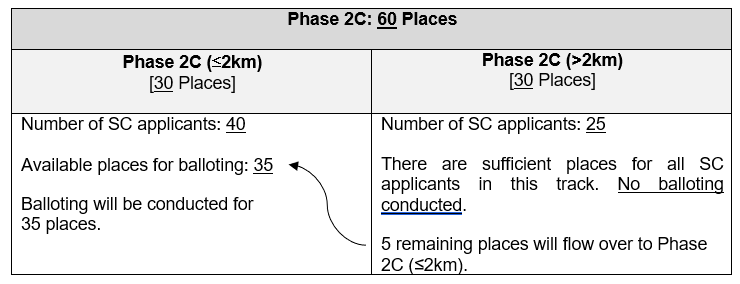
Notes:
- The total number of places available for Phase 2C, which includes the 60 reserved places, will be split equally between the two tracks. There may be additional places in Phase 2C beyond the 60 reserved places, if there are more places than applicants in Phases 2A and 2B – these places will flow to Phase 2C. The worked example above is for a school that has the minimum of 60 reserved places for Phase 2C and no remaining places from the earlier phases. These 60 places will be split equally into 30 places for Phase 2C (≤2km) and 30 places for Phase 2C (>2km).
- If there are remaining places after all SC applicants are admitted, Permanent Resident (PR) applicants can be admitted. The remaining places will be equally allocated to the two tracks for PR applicants.
Q5. Will the Two-Track Scheme disadvantage families living in public housing within 2km of a school? Why is the Phase 2C (>2km) track not exclusively reserved for families living in public housing outside of 2km, given that the intent of this track is to diversify the school's socio-economic mix?
The Two-Track Scheme is intended to balance two important objectives: preserving access for children living near the school, while opening the 12 schools to a more diverse socio-economic mix of families beyond those living in their immediate neighbourhood.
Families living within 2km of the school will continue to have places set aside for them under the Phase 2C (≤2km) track. At the same time, the Phase 2C (>2km) track creates opportunities for these schools to enable their student profiles to better reflect the diversity of our society.
Q6. With the Two-Track Scheme, children living in the vicinity of these 12 schools may now be crowded out of these schools. Has MOE ensured that there are sufficient places in other nearby schools to ensure that these children can continue to attend a school relatively near their home?
MOE regularly reviews the provision of Primary 1 places, taking into account factors including demographic trends and upcoming housing developments. While demand varies across schools depending on parents' preferences, MOE plans sufficient Primary 1 places for our children at both the national and regional levels, to enable children to be able to attend a school relatively near their homes.
Q7. What happens when the number of Phase 2C places cannot be neatly divided between the Phase 2C (≤2km) and Phase 2C(>2km) tracks, i.e. an odd number?
When the number of Phase 2C places cannot be neatly divided, the additional place will be allocated to the Phase 2C (≤2km) track.
Footnotes
- About 8 in 10 of Singapore's resident population live in public housing (HDB flats).
- Parents can check their home-school distance from their preferred primary school at www.onemap.gov.sg/school.
- SCs will continue to have priority over PRs under the Two-Track Scheme. All SC applicants under both tracks will be admitted first, before PR applicants are considered for any remaining vacancies thereafter.