


1. Government agencies have been conducting stepped up enforcement against the use of e-vaporisers. The Ministry of Education (MOE) works alongside health and enforcement agencies, schools and Institutes of Higher Learning (IHLs) to fight vaping among students through education, prevention, and support.
Understanding the Threat
2. A youth sentiments survey conducted by the Ministry of Health, Health Promotion Board (HPB) and National Youth Council in 2023, found that 69 per cent of youths know that vaping is illegal in Singapore, and 68 per cent of youths are aware that vaping is harmful to health. Notwithstanding the illegality and health harms of vaping, the top three reasons why youths vape include that e-vaporisers have more flavours than traditional cigarettes, influence from social circle and for stress relief.
3. Many young people also wrongly believe vaping is "safer" than smoking. When combined with peer pressure, these factors make vaping seem normal and acceptable to youth.
4. E-vaporisers can contain harmful substances such as etomidate, which can cause severe effects — from confusion and loss of consciousness to even death. Thus, we need to act quickly before more of our youth's lives are destroyed by vaping.
Education as the First Line of Defence
5. Education is a key strategy in preventing vaping. Education on vaping prevention is built into our curriculum across all educational levels. This helps students make informed, healthy choices when they face peer pressure or misinformation.
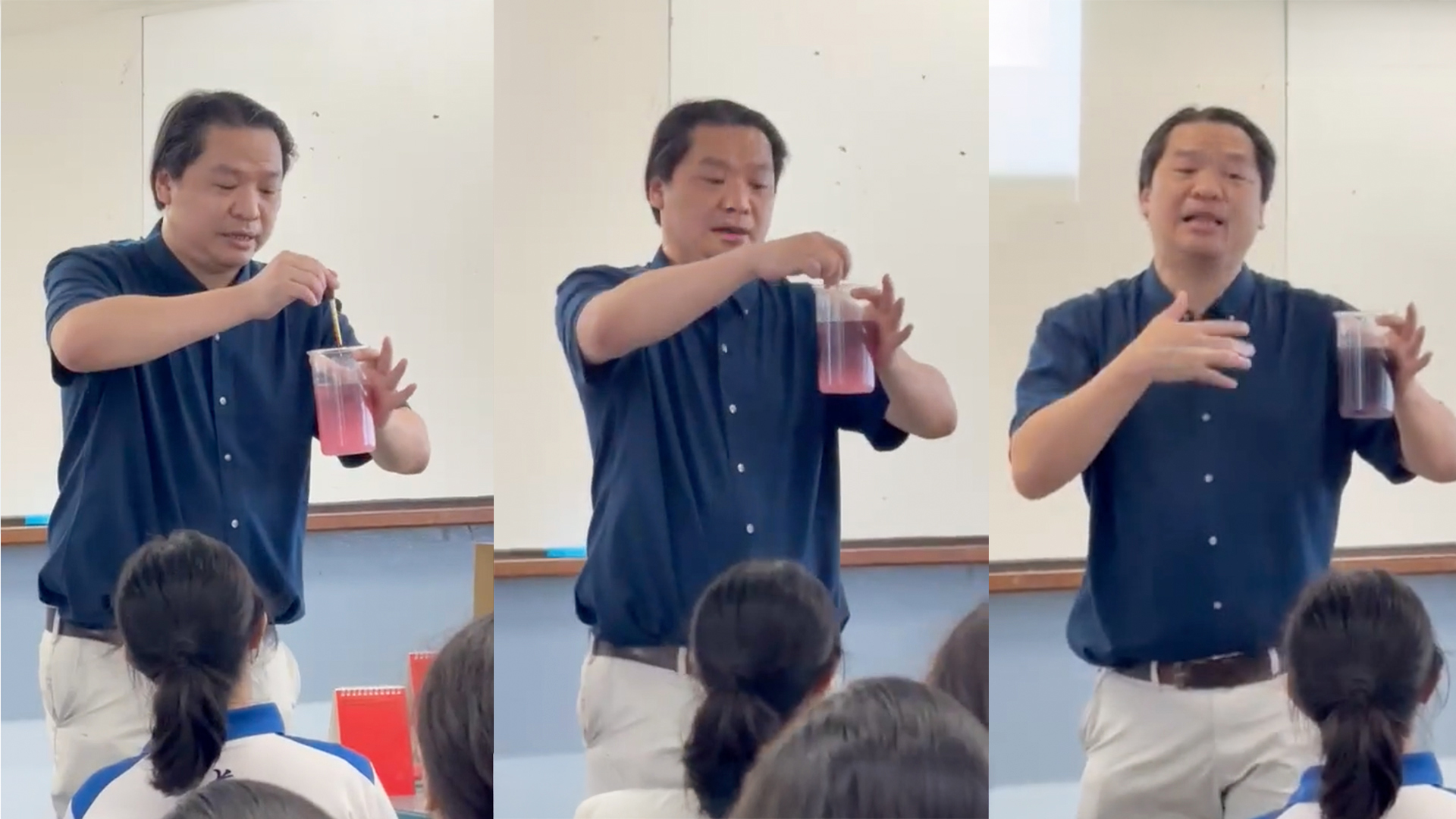 A Science Teacher using a colour-change experiment to demonstrate how seemingly harmless substances can cause harmful chemical reactions to the body.
6. In schools, age-appropriate content on vaping prevention is covered through various subjects. Students learn about the science of addiction and the negative health impact of vaping through Physical Education and Science lessons. Through real-world examples, students understand how vaping can lead to dependency, and learn strategies for refusing vaping, smoking and other substances.
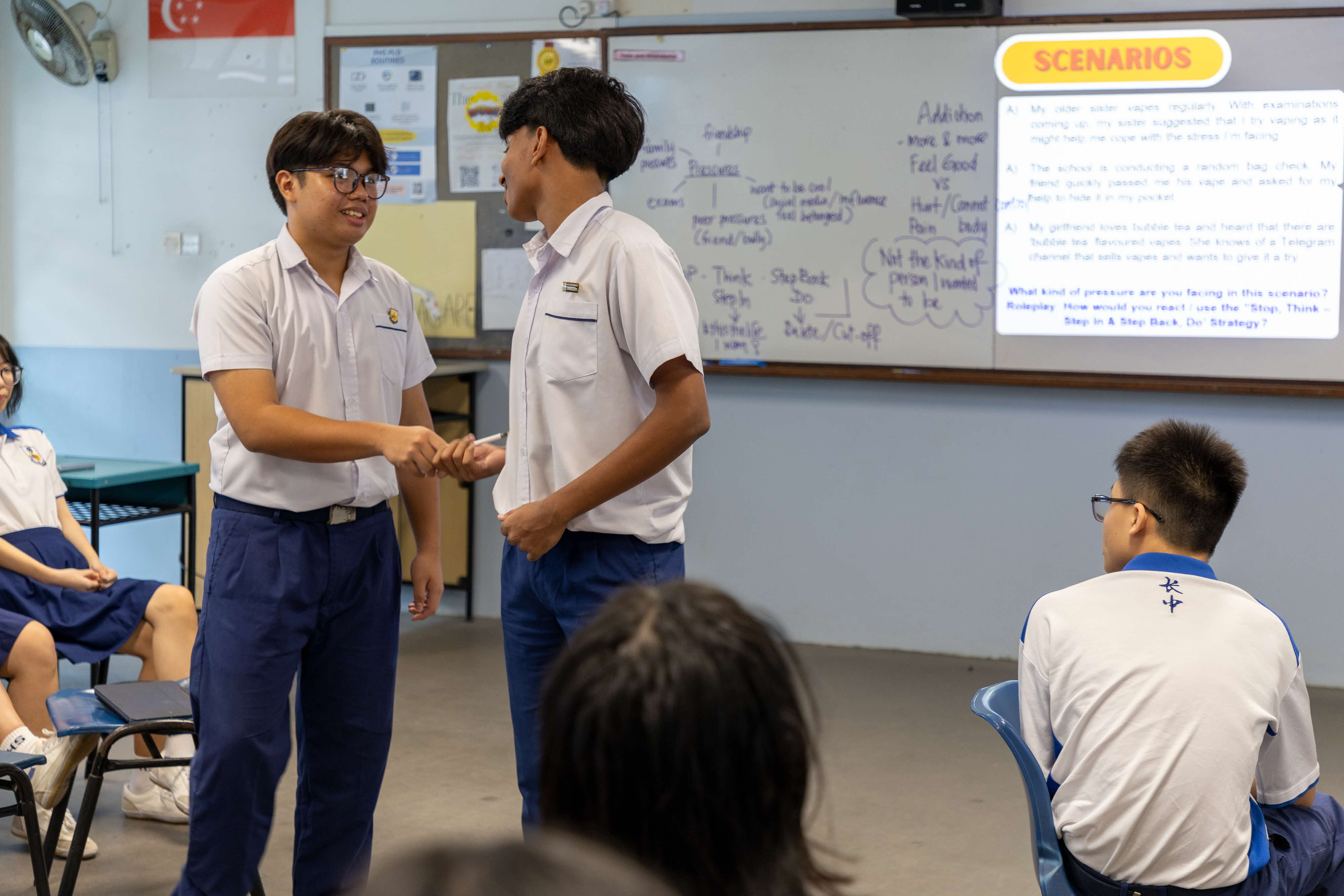 Students learning through role play in CCE lessons.
7. Building on this, Character and Citizenship Education (CCE) helps students gain social-emotional skills to resist peer pressure. Students learn to control impulses toward risky choices by considering consequences and priorities. Through guided class discussions and practical exercises, they understand how to make informed, healthy choices.
8. In addition, schools have established peer support structures. Through CCE, students learn to listen actively, respond with empathy and encourage their peers to seek help early and choose positive coping strategies. Peer Support Leaders also look out for their peers who need support.
9. School staff are equipped with resources on smoking and vaping prevention, including guides on vaping legislation and enforcement in Singapore, myths about smoking and vaping, approaches to support students in breaking the unhealthy habit and procedures on reporting cases to the Health Sciences Authority (HSA) when necessary. Schools also share approaches to better manage student matters including vaping through learning communities.
10. In the IHLs, compulsory orientation modules and briefings establish clear expectations about anti-vaping regulations and consequences for committing an offence. The IHLs also tap on social media to share youth-appropriate messaging and encourage peer-led responsible behaviour.
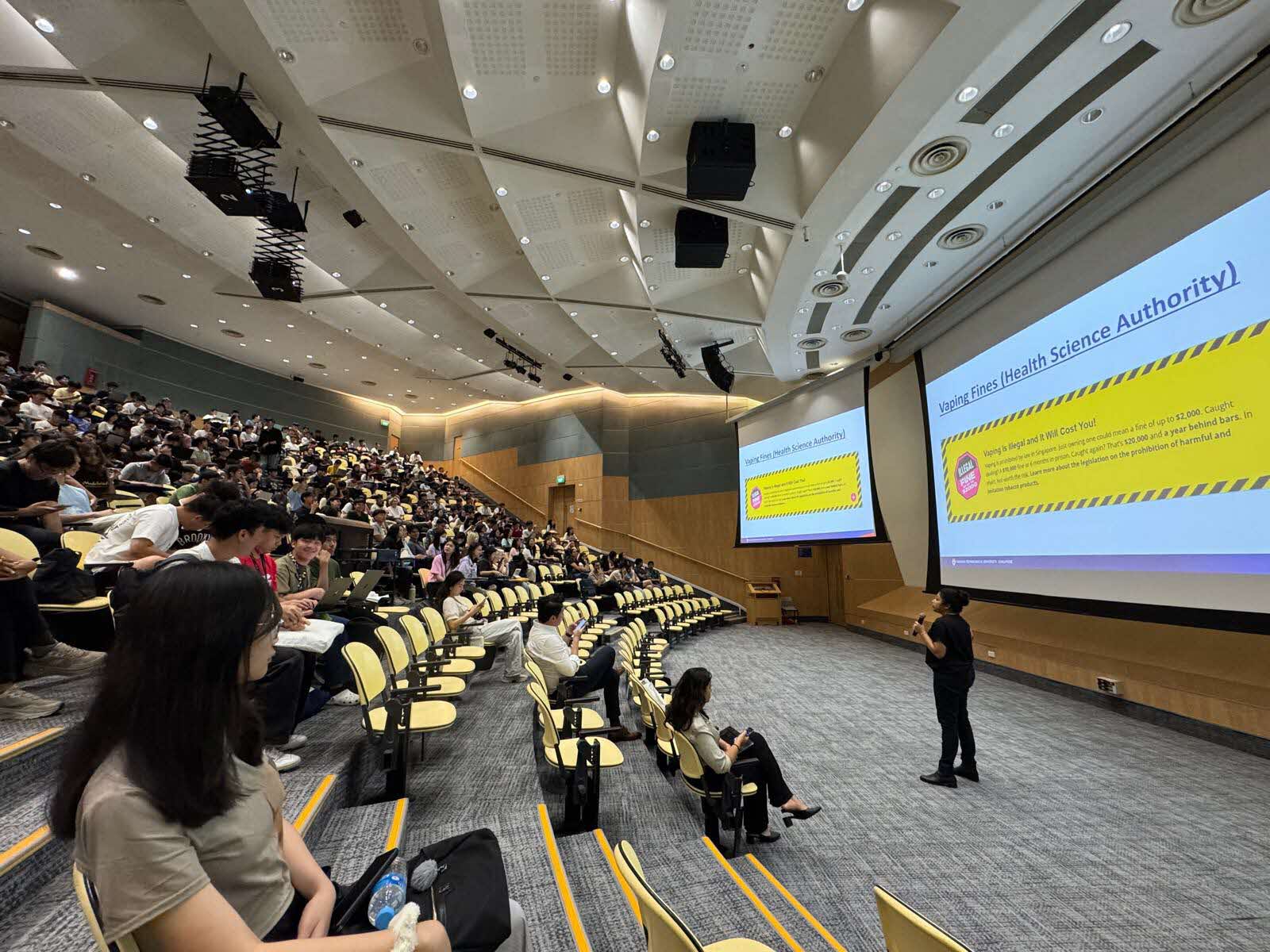 The IHLs conduct outreach talks for all students in Polytechnics and ITE, as well as targeted programmes for those staying in hostels in the Autonomous Universities.
11. IHLs have also engaged students and staff to watch out for people selling e-vaporisers around campus, and to promptly report them to HSA. Students who are vaping are encouraged to seek support to quit.
Strengthening Prevention Through Partnerships
12. Students can be powerful advocates against vaping. HPB launched a pilot programme to train student leaders in three uniformed groups as vape-free ambassadors within their school communities.
13. These ambassadors learn about Singapore's regulations on nicotine products, the harms of vaping, youth vaping trends, and marketing tactics targeting young people. Armed with this knowledge, they engage their schoolmates through various peer-led initiatives and help friends find support to quit vaping when needed.
14. IHLs also work with relevant government agencies to integrate anti-vaping and related messages into existing student engagement platforms. Examples include the Singapore Institute of Technology's Safety Fair, which featured a booth with student volunteers sharing key messages from HPB's anti-vaping materials. The Institute of Technical Education also partners the Central Narcotics Bureau on an educational package for students that highlights the harms of drugs, including the dangers of drug-laced e-vaporisers.
Clear Consequences, Targeted Support
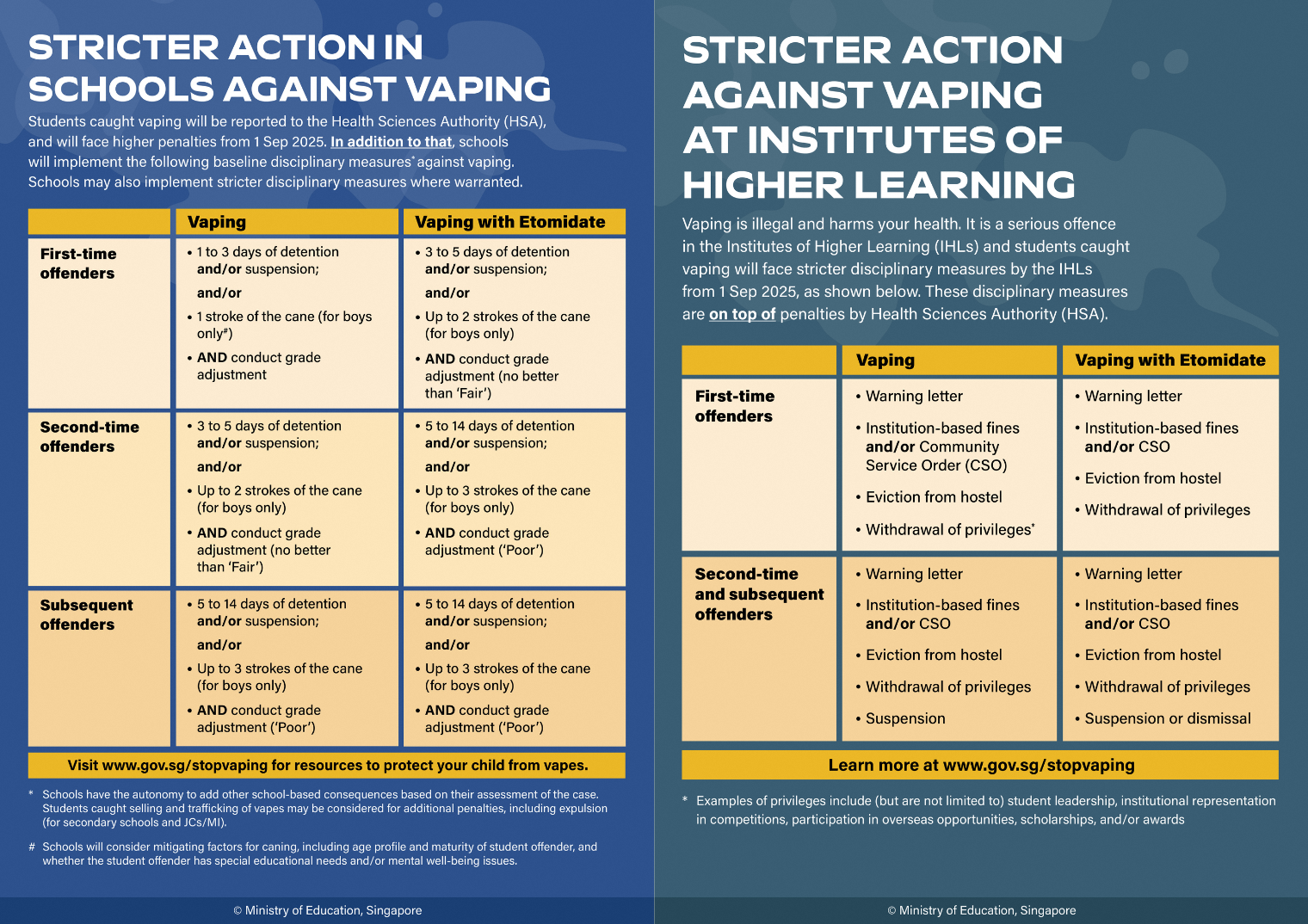
15. While education and prevention are important, they must be backed by clear consequences when students break rules. If students (including first-time offenders) are caught using or possessing e-vaporisers, the items are confiscated, and they are reported to HSA. For students in schools, parents are also informed. The authorities then issue a Notice of Composition – a fine of $500 for those aged under 18 and $700 for adults. Those who refuse to pay this fine could be taken to court and fined up to $10,000. Those found vaping again will be required to attend rehabilitation programmes.
16. Schools and IHLs have additional disciplinary measures to make it clear that vaping is a serious offence. These disciplinary measures are on top of Singapore's enhanced penalties against vaping. Punishment is always paired with support to help students make better choices. This includes mandatory counselling and rehabilitation efforts supported by social service agencies, to guide students to change.
Supporting Students to Quit
17. Some youth may struggle with vaping addiction. The QuitVape Programme and HPB's QuitLine (1800 438 2000) provide cessation support designed for youth. Any admission of consumption shared during the programme remains confidential and is not reported to the authorities.
18. In schools and IHLs, professional support is available. Trained counsellors provide guidance for affected students and work to identify at-risk students and develop individual support plans. IHLs also offer specialised smoking and vaping cessation programmes, that are regularly shared through health advisories and institutional channels.
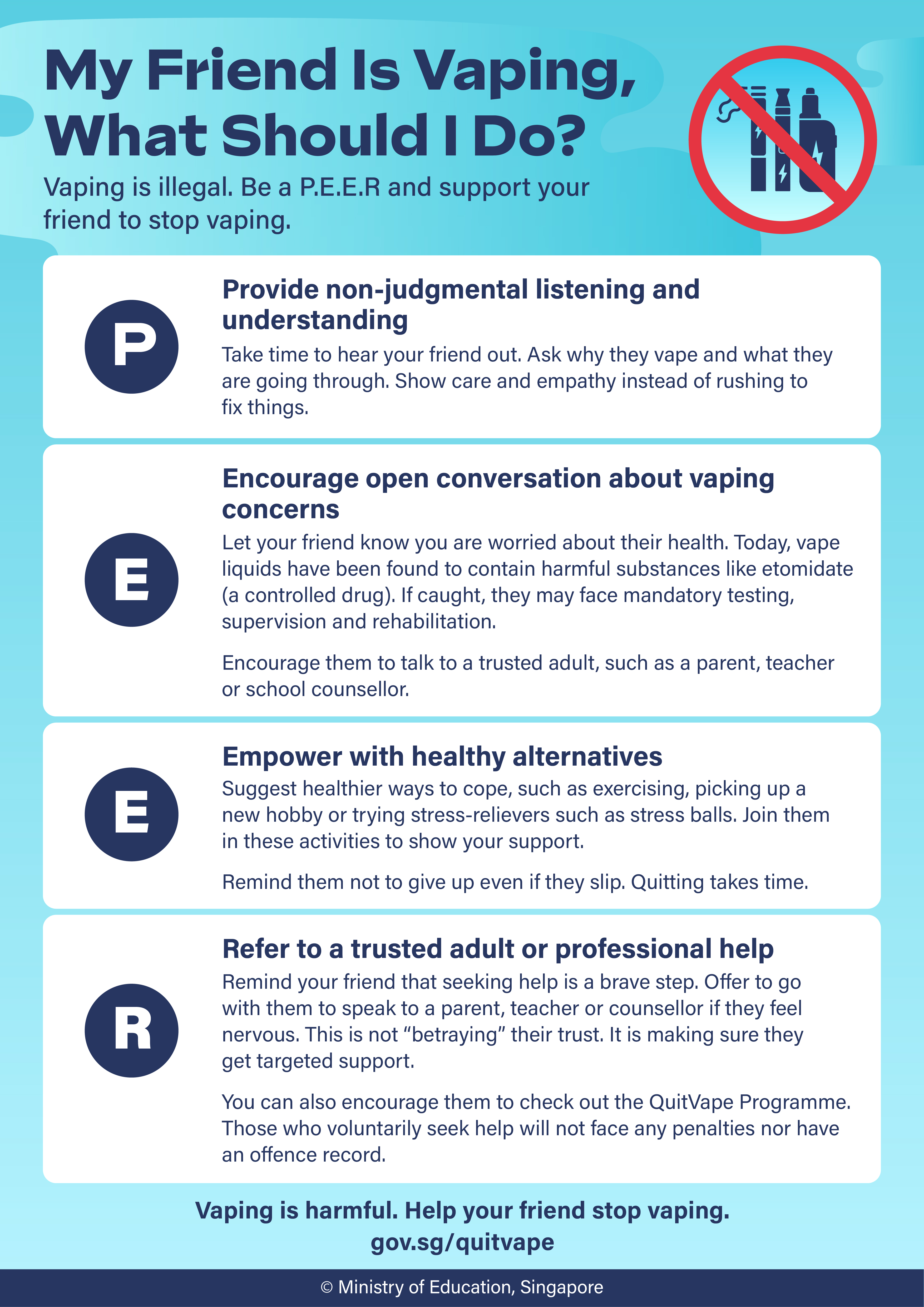
19. Students can support each other through peer programmes using strategies such as the PEER approach, which teaches them how to have helpful conversations with friends who might be struggling.
Engaging Parents as Partners
20. Fighting vaping also requires strong family support. When parents talk to their children about the dangers of vaping early and model healthy behaviour, youth are far less likely to experiment, even when facing negative peer influence.
21. MOE works with HPB and HSA on joint advisories to parents that emphasise both the illegality of e-vaporisers and the harmful effects on one's health. Parents can access additional resources through multiple channels: Parent Hub, Parenting For Wellness, the Families for Life Parent's Guide on Vaping, and comprehensive information at gov.sg/stopvaping. These resources help parents navigate serious conversations with their children, working together to prevent vaping.
Our Shared Responsibility
22. Beyond government efforts, parents and the community have important roles to play as well. This shared responsibility ensures students get consistent support wherever they are – at school, at home, and in the community.
23. Our goal is not just to stop students from vaping, but to help them become strong, informed, resilient young people who can make healthy choices throughout their lives.